Showing posts with label Reading Reflection. Show all posts

Sunday, November 22, 2015

Oh That Word Classroom Management..


Classroom management is a word when brought up in discussion that can make your body cringe or rub it off because it is just another word used in the educational field.  Either way it is something that takes time and something one will not master in a school year or two.  From our reading and my recent microteaching experience what I experienced lined right up with what was written.  I encountered many of the challenges a teacher faces on a daily basis.  I also, not knowingly incorporated some teacher tactics to properly manage a classroom full of rambunctious teenagers.  Here are some key points that I picked up from our reading and experiences that lined right up with our reading.

To begin with clarity and organization is vital.  I have struggled with clarity this semester during my weekly teaching labs.  I have seen the importance in being clear in concise when speaking to my students.  I have gotten better at this and my student teaching experience will be a good time for me to really hone in on clarity.  As for organization that is a no brainer.  Being organized will make things go ten times smoother.  I witnessed this first hand during my microteaching experience.  Having all my materials and plans set up in the order I planned to use them allowed for me to go right from one activity to the next.  This consistency throughout my three days teaching proved to me the power of organization.

Start out firm you can always loosen up later.  I have heard this statement numerous times and hey… guess what it is so true!  During my microteaching experience I never really had any big problems, but I did not start out as firm as I should have the first day.  Setting precedence is very important!  I learned this and it is something I will file away come student teaching time. 

Meaningful work is what you must provide to your students.  When students view the assignments you are presenting to them only as busy work students will begin to misbehave, cut class, and become disengaged in the material you are presenting.

Routines are the way it is meant to be.  We are creatures of habit.  When you start every day greeting your students at the door, have bell work on the board for students to complete when they come in, and possibly pick up their folder or notebook for the class in a bin marked for their class it makes starting class that much easier.  If every day was different you would have to tackle the situations that arise most likely in a different manner.  Having that routine greatly reduces the chances of misbehavior amongst your students.

Praise praise praise and praise some more.  Who doesn’t like to be praised when they do a job well done?  Let your students know how much you appreciate their interaction in your class.  When students are acknowledged for their good behavior and hard work they are more likely to continue to do so.  I noticed this first hand during my microteaching experience.  When I acknowledged students by their name and thanked them for their participation I noticed the power of doing those two simple things.  However, it is very important not to have favorites.  Students will pick up on this fast and become disconnected and begin causing issues. 

      We all know that there are going to be times when classroom management problems will arise in our classroom.  When they do, it is important to hit them head on and be straight, be blunt, be short, and move on.

      One final note about classroom management would be setting a good example.  Be a positive role model.  Typing this I think back to my high school career.  There were a few teachers I became to know very well in school and also out of.  These men stuck to the beliefs they believe in and have never led me astray.  Their perspectives, advice, and way they live life make me strive to be the best that I can be. 

      There you have it classroom management in a nutshell. 

Sunday, November 1, 2015

Inquiry- the dynamic process of being open to wonder and puzzlements and coming to know and understand the world


When you combine curiosity, the scientific method, and critical thinking skills into your classroom what do you have?  What you have is inquiry-based teaching.  With this method of teaching students encounter problems they do not yet fully grasp or have no prior knowledge on.  This type of instruction allows for students to formulate questions, explore the problem by digging deeper into the root of it, observing, and applying new information to find meaning to what they are questioning. 

Students partake in five activities while engaging in inquiry learning.  These activities have no set order and they can go back and forth from one to another.  Also, applying new information they learn upon their journey or pull out previous knowledge and skills they already have to assist them in solving the root of their problem or question.

1.      Question

Students ask what it is they are trying to solve.

2.      Investigate

Students begin to examine and explore what it is they are questioning. 

3.      Use evidence to describe, explain, and predict;

Students formulate what they gathered from step two.

4.      Connect evidence to knowledge; and

Students find meaning between what they observed and already know.

5.      Share findings

Students explain what they witnessed.

However, inquiry instruction does not end there.  True, great inquiry instruction incorporates the 5-E Model.  This model emphases engagement, exploration, explanation, elaboration, and evaluation to complete classroom objectives and focus in on specific concepts the teacher has set forth.

·         Engagement

Have a solid interest approach.  Grab your students!  Make them use their brains, but also give them that desire to want to.  During this stage as well questioning and investigating begin.  Students draw on prior knowledge they have. 

·         Exploration

Immediately following engagement students transition into exploration.  During this time students cross reference materials, make discoveries, and possibly share their findings with their peers or teacher. 

·         Explanation

During this stage the teacher has his/her students share out what they discovered and explain it to the class.  The teacher will also possibly introduce relevant concepts, principles, or theories as the need arises.

·         Elaboration

Students apply real world experiences to the situation they were studying more about.  They also go beyond memorization and use their critical thinking skills to answer the problem or question being set forth for them. 

·         Evaluation

The teacher assesses how the student performed.

In conclusion inquiry based instruction allows for students to take control of their learning experience.  Done right it is a great way to add another teaching technique to your tool box of instruction.

Sunday, October 11, 2015

Problem Solving with a Purpose


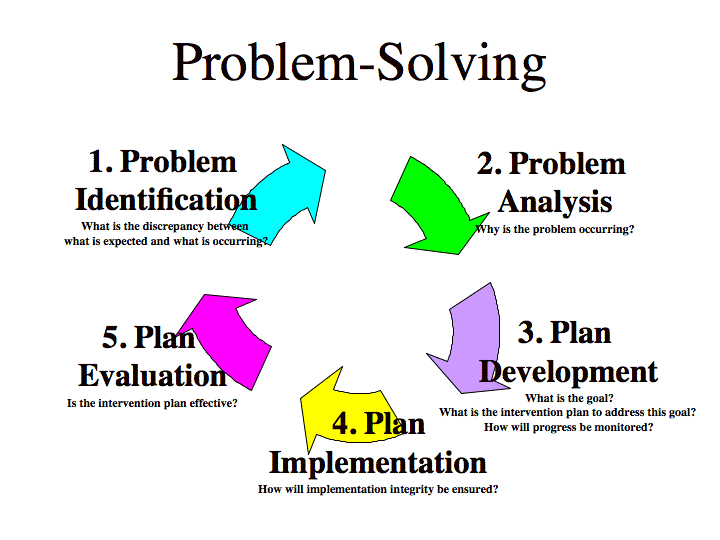
The demand for students that can successfully problem solve is a skill that the workforce is looking for in prospective employees.  Many teachers are revising their curricula to encourage higher orders of thinking on their students.  When problem solving students go through three cognitive activities to find a solution to the problem. 

1.      Represent Problem- Students find appropriate context knowledge, and seek the end goal and starting conditions of the problem.

2.      Solution Search- During this stage students refine the goal they are seeking and develop a plan of action to reach their end goal

3.      Implement Solution- Students execute their plan of action and then evaluate the results.


When implementing problem solving through the use of projects there are eight important steps to consider making the assignment purposeful and meaningful for your students.

1.      Identify the significant content you want your students to fully understand.  Outline the basis of the important knowledge you would like students to become familiar with.  This should reflect what you as an educator believes are essential for their learning process on the topic.  In turn students will find material and terms they believe are significant in their own lives.

2.      Grab students attention from the get go!  Provide an “entry event” that gets the students interested and engaged.  Some examples are video clips, group discussion, guest speaker, and a field trip.  Sparking students’ interest rather than passing out a handout and telling them they need to know this because it is on the test is a poor way to get students to fully use their problem solving skills. 

3.      Be sure to have a driving question.  A clear driving question provides a sense of reasoning for the assignment and also a challenge presented to them.

4.      Allow for student input.  Provide multiple outlets for completing the project.  Allow for a written paper, oral presentation, and media technology.  Students articulate and solve problems in many ways don’t constrict your students learning and thought process.

5.      Create a project replicated to the workforce.  Allow for collaboration, communication, critical thinking, and the use of technology.  Incorporating these facets into your assignment create purpose and allow for reflection.

6.      Dig deeper.  Have students ask questions and stem off of topics already being examined.  Students find more meaning in work when they can relate it to real life issues.

7.      Feedback & Revision.  In doing this students realize the importance of creating high quality products and that their first attempt at something is usually not their last.  It explicitly relates to the workforce and that revisions are an integral part of creating high quality products.

8.      Present your product!  Show off your work.  Present how you arrived to your final solution.

In conclusion when creating an assignment centered on problem solving make it meaningful!  Do not create it just for the sake of completing the assigned material and moving on to take the test.  Upon completion of the project have students present their findings or creation to an audience.  Students care more about the quality of their research and problem solving strategies when they know they have to present it.  Doing this students acquire a taste of what professionals in the workforce are looking for, after all isn’t that what we as educators are preparing our students for?  Real world experiences in an atmosphere where they can succeed and fail without any repercussions.

Check out this short interesting read about problem solving.


Sunday, September 27, 2015

You're Gonna Go Far Kid!


It has been said before it doesn’t matter what you say, but how you say it.  When you say nothing at all you are doing no one a service.  Listening is just as important as speaking and vice versa.  Living in a world that is now so connected we interact with multiple people on a daily basis.  Having the ability to articulate thoughts and speak constructively with others is largely important for success.  However, along the way from disconnect to connect in the 21st century world we have begun to ignore people who don’t think quite like us, dress differently, listen to music not of our liking, or come from a different cultural background.  The list goes on and on.  Adults are more prone to this than adolescents, but never do adults get reprimanded for the way they think or speak. 

I’ll get off of my soap box now and jump into what I took from the videos and readings for our AEE 412 reading reflection this week.  Angela Maiers talked about how YOU MATTER as an individual.  Students today do not get the positive reinforcement they so critically need.  This does not just relate to little Johnny in third grade who spelled a word right on his spelling bee exam, but to Sarah who is a high school junior who struggles with her biology assignments.  She always turns her work in and whether it is right or wrong she deserves the praise and positive reinforcement to keep her motivated.  So that she keeps trying and does not spiral into this whirl wind of failure and not caring. 

While listening to that video I kept thinking about past experiences I have had.  One thing that stuck out to me was the dairy farmer at home I work for.  I have admired the man ever since I started working for him several years ago.  My admiration towards him has built ever since.  My reasoning for that is he makes me feel like I am truly important and needed in the success of his operation.  While I know he can certainly get by without me he does truly mean it when he says “I couldn’t have done this without you, I’d still be in the barn doing chores if you hadn’t shown up, thank you.” Or in speaking to his wife right in front of me “Mason did a great job today filling silo.”  I have to tell you hearing praise like that makes you feel like YOU MATTER.  This is something I hope to incorporate into my classroom when I become an agricultural educator.  There have been days when the two of us have been up in the silo sweating to death leveling it off with pitch forks and the unloader just won’t set properly.  After an unanticipated time up there he will say “PERFECT!”  There is no sense in being a negative Nancy and our public school systems and students we will one day teach do not need another negative Nancy on their butts.  Students need recognition and positive reinforcement even if things do not go as planned. 

Also, coming up as an assignment in our AEE 412 class is a genius hour.  Before I read the assignment I thought it dealt with technology and how we will incorporate digital devices into our classroom.  Oh how I was wrong.  A genius hour is when I take the time to study and become more knowledgeable in anything I choose fit.  I gave it some thought this morning and what I would like to study is music.  Now that is a very generic statement so I am calling upon you my viewers to give me advice on where to take this.  I have a love for music.  I listen to all sorts of genres.  I listen to certain music when I am in a certain mood.  There’s specific music I listen to when I’m doing homework and other types when I want to just lose my mind.  Maybe I will set up some sort of graph and survey people with a list of questions you the audience and I come up with?  I’m excited to see where this goes.    

Sunday, September 20, 2015

So You Want to be an Agricultural Educator?


For our second weekly reading within The Agricultural Education Magazine there was an article that strongly related to me.  Looking back and drawing on personal experiences I now see the benefit of effective planning, having strong organizational skills, managing a program, and incorporating community involvement into a program. 

Planning and Preparation > Planning on the go

When planning and preparation is put into constructing an effective lesson plan student understanding and knowledge of the material being presented to them is exponential!  Looking back on my own experiences throughout high school in my agriculture program my instructor always had clear objectives stated on the board that he planned to get through before our time together was up.  He also took the time to figure out what was the best way to convey theories and information.  When we were learning about electricity he would use the white board and multiple colored markers to show us different types of circuits.  Plumbing for instance he would bring in the actual pieces commonly used and have them taped to the board with their name while we were going over a worksheet on how to properly set up a drain or water line.  Bottom line it is crucial to put the time in ahead of the teaching lesson so the time spent on that lesson is most effective.

Whenever in doubt organize it out!

One skill in the teaching profession that will make your life much easier is having strong organizational skills.  If you have all your materials and a focus with a clear end objective in mind your already well on your way to succeeding and providing the best learning experience to your students.  I noticed this too in my agricultural educator.  He always had links uploaded prior to class.  His lesson plans were laid out on his desk to glance at or if there was a sub for a particular day.  Most of all it was noticeable in the shop.  For the most part it was clutter free.  We all know no agricultural mechanics shop is 100% clear of clutter.  Having tools and materials in their designated area made working in the shop that much easier.

Oh you have a managerial position?  But you’re a teacher.

Being an ag. teacher doesn’t just mean you teach the reproductive system of a cow or how small gas engines function.  You wear many hats and one of them is being a program manager.  There are many functions and activities outside of the ag. classroom.  Being well organized and managing these things properly makes your job more fun and allows your students to get the most out of being in your class or the FFA.  When I think about this and relating it back to my high school experiences.  I vividly remember my ag. instructor always having a list of important dates on the whiteboard.  Around banquet time we the members coordinated it for the most part, but our advisor was there to keep us on track.  In the shop I remember working on hay wagons and while we all couldn’t be welding on the sides he would have some of us cutting metal out, others welding the sides on, and a few cutting the boards out for the floor.

Get the community involved!

Community involvement and support makes just a good ag. program a great ag. program.  I could go on and on about why an ag. program needs community involvement, but it’s quite simple it helps you as an educator get supplies and resources for your program and offer opportunities for your students to get hands on experiences.  This topic relates the most to me and is what made my experiences in the ag. program leave a lasting impression on me.  I joined the dairy judging team my ninth grade year.  My teammates and I decided to take it serious so local farmers who had invested time and money into the program graciously decided to coach us.  Looking back on it now my ag. teacher making those relationships and finding the people who could enhance our skill set really means a lot to me.  My tenth grade year of school I wanted to show a market steer so my ag. instructor hooked me up with a local farmer who raised beef cattle.  It turned out to be one of the greatest experiences of my life.  I showed market steers all through high school and still work on their dairy/beef cattle operation.

So being an ag educator means so much more than discussing the differences between conventional tillage and no-till.  We have a lot resting on our shoulders to make our students and program successful.  With careful preparation, organization, good management, and community involvement our path to success can be a whole lot easier.